The Revelation of Jesus Christ: A Verse-by-Verse Commentary
The Commentary
The Revelation was not given to hide the truth from God’s people. Its very name tells us its purpose: to reveal.
This commentary approaches the Revelation with a simple conviction: Scripture must be allowed to interpret Scripture. Rather than beginning with speculation concerning current events or attempting to force the prophecy into a predetermined system, we begin with the text itself, following its language, symbols, and prophetic message throughout the Word of God.
The Revelation of Jesus Christ
“The Revelation of Jesus Christ, which God gave unto him, to shew unto his servants things which must shortly come to pass…” Revelation 1:1, KJV
The first words of Revelation establish the foundation for everything that follows. This book is, first and foremost, the Revelation of Jesus Christ.
Its visions may be vast. Its symbols may be mysterious. Its prophetic scope reaches across generations. Yet at the center of it all stands Christ.
He walks among the seven golden candlesticks. He opens the seals. He rules among the nations. He leads His people through conflict and persecution. He conquers every power raised against His kingdom. And when the Revelation reaches its conclusion, He remains the Alpha and Omega, the beginning and the end, the first and the last.
To understand the Revelation, therefore, we must never lose sight of the One being revealed. Every vision ultimately belongs to the Revelation of Jesus Christ. The purpose is not simply to understand prophecy. It is to see more clearly Christ, His church, His kingdom, His conflict with evil, and His ultimate victory.
For this reason the commentary is Christ-centered rather than organized primarily around speculation about future events.
Scripture Interprets Scripture
“For precept must be upon precept, precept upon precept; line upon line, line upon line; here a little, and there a little:” Isaiah 28:10, KJV
Few books of the Bible have generated more interpretations, timelines, charts, theories, and speculation than Revelation. Yet the Revelation was given to the servants of God. It was meant to be understood.
The difficulty often begins when we attempt to interpret its symbols primarily through modern headlines, political events, or human speculation rather than allowing the Bible to explain its own prophetic language. Scripture gives us another way.
The Bible provides its own language of prophecy. When Revelation speaks of candlesticks, stars, beasts, horns, waters, mountains, trumpets, witnesses, a woman, a dragon, Babylon, and other prophetic symbols, we first search Scripture to understand how that language is used elsewhere in the Word of God. Throughout this commentary, symbols found in Revelation are traced through the rest of Scripture. Old Testament prophecy illuminates New Testament prophecy. The words of Christ illuminate the visions given to John. Scripture quotations are from the King James Version.
History in Its Proper Place
The Revelation was given within history and unfolds across history. Historical events therefore matter. But history does not become our dictionary for prophetic symbolism. Scripture establishes the meaning of the symbols, while history helps us recognize their fulfillment. The purpose is not to make Revelation say something new. It is to understand what God has already said.
A Verse-by-Verse Approach
Volume I examines Revelation chapters 1 through 3.
Explore Volume IRevelation deserves more than a hurried journey toward its most dramatic visions. This commentary begins at Revelation 1:1 and follows the text carefully, allowing each passage to establish the foundation for what follows.
Chapters build upon chapters, and each volume builds upon the scriptural foundation established by those preceding it. Volume I begins with John’s vision of the glorified Christ and continues through Christ’s messages to the seven churches of Asia.
The Prophetic Framework
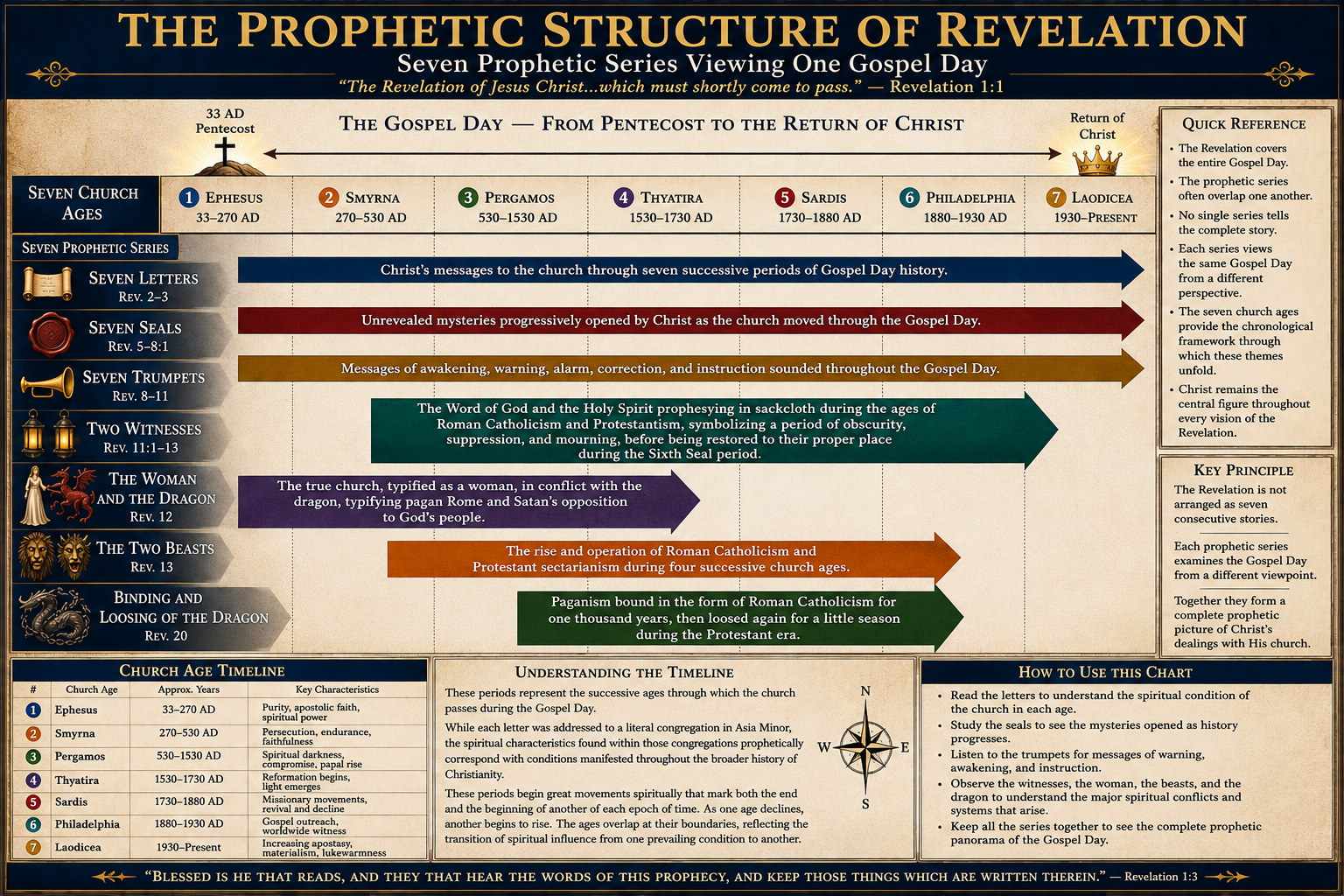
The commentary recognizes the seven churches of Revelation 2 and 3 as actual congregations in Asia Minor. It also understands them prophetically, as successive periods in the history of the church during the Gospel Day, which extends from Pentecost to the return of Christ.
The Revelation is not arranged as seven consecutive stories. Instead, seven prophetic series each view the same Gospel Day from a different perspective:
- The Seven LettersRev. 2–3
- The Seven SealsRev. 5–8:1
- The Seven TrumpetsRev. 8–11
- The Two WitnessesRev. 11:1–13
- The Woman and the DragonRev. 12
- The Two BeastsRev. 13
- The Binding and Loosing of the DragonRev. 20
These series often overlap one another, and no single series tells the complete story. Together they form a complete picture of Christ’s dealings with His church, and the seven church ages provide the chronological framework through which these themes unfold.
The dates assigned to the church ages are approximate guideposts, not rigid boundaries, and the ages overlap at their transitions. This is the interpretive framework followed in this commentary. Christians have understood the Revelation in a variety of ways, and it is not presented as one that every tradition shares.
Explore the seven church agesThe Commentary Series

Christ Among the Candlesticks is Volume I of a larger verse-by-verse journey through the Revelation. It covers Revelation chapters 1 through 3.
The first volume establishes the foundation: Christ, His church, the seven church ages, and the prophetic framework necessary for understanding what follows.
Future volumes will continue through the text as the seals are opened, the trumpets sound, the great prophetic symbols emerge, and the Revelation progressively unveils the conflict between the kingdom of God and the powers arrayed against it. Each volume will build upon the scriptural foundation established by those preceding it.